For wineries all across California, August through October is a magical time of year known as “grape-crushing season.” After the best grapes have been harvested—the ones that have ripened properly, and are free of rot or damage—winemakers get busy crushing them. While crushing grapes by foot may have been the way to go in the past (or was that just a storyline in “I Love Lucy”?) nowadays most wineries use large, automated machinery to streamline the process before transferring the resulting juices into a vat for fermentation.
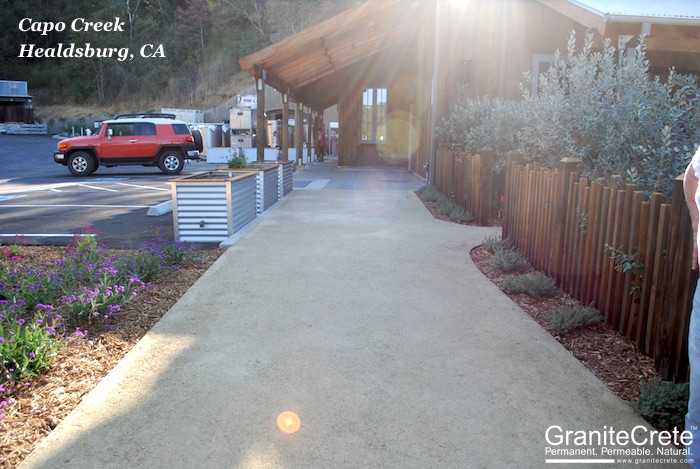
In honor of grape-crushing season and the astounding volume of wine created—California’s winemakers are responsible for 81% of the United States’ wine production!—we want to take a moment to showcase some of the wineries across the state with installations of GraniteCrete, and to congratulate them on their commitment to sustainability.
“We are very pleased with GraniteCrete. The installation was clean and easy, and the finished look is so natural. The product is environmentally sound, is ADA compatible, and the color choices are spot on. I would enthusiastically recommend this product to anyone looking for an alternative hardscape choice!”
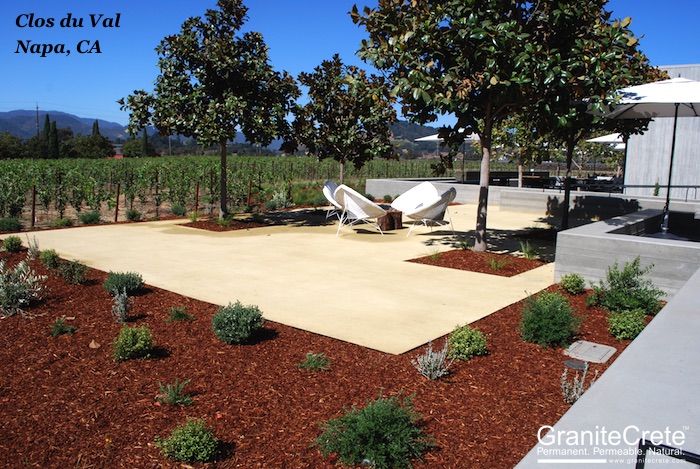
At Clos du Val, outdoor umbrellas are provided to keep patrons cool during sunny weather. These umbrellas are attached to rolling bases with very small wheels, which they quickly realized were difficult to roll across the decomposed granite originally installed at the winery. Despite having a stabilizer mixed in, the decomposed granite simply wasn’t sturdy enough. To correct this issue, a switch to GraniteCrete was suggested. The GraniteCrete has proven to be a much harder surface that is “working perfectly.”
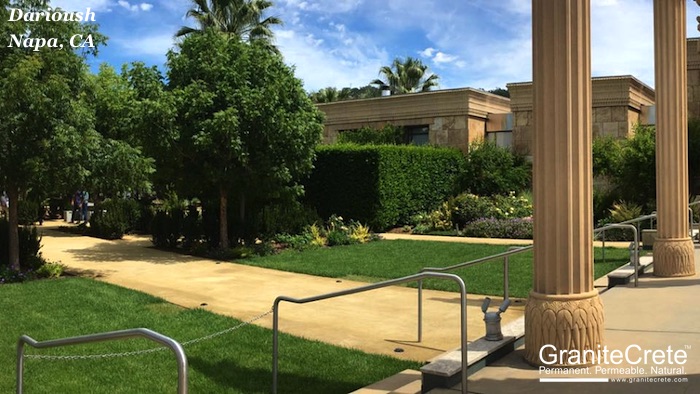
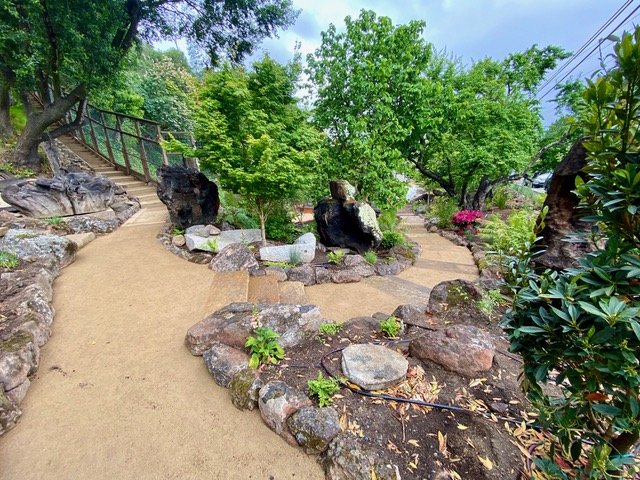
Darioush winery features a beautiful GraniteCrete pathway that complements the abundant greenery and surrounding architecture. Outdoor lighting has been set into the path along the edges to help patrons find their way – easy to do with GraniteCrete!
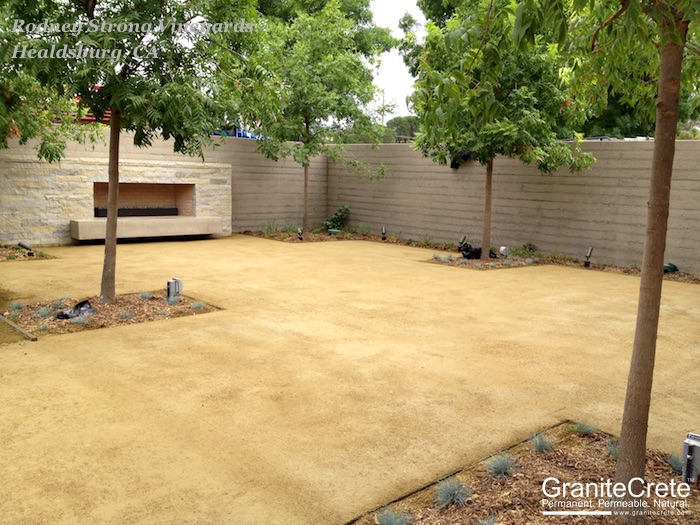
The outdoor area at Rodney Strong Vineyards is the perfect place for visitors to relax and enjoy a glass of wine – whether that be on “Wine Wednesday,” or another day of the week. Made from GraniteCrete, the patio does not absorb heat, keeping it nice and cool even during the hot summer months.
When I was first developing GraniteCrete, I knew the importance of replenishing our water table; how precious water is to our planet. When we had GraniteCrete tested and found out it was permeable we were ecstatic. Not only did we have a green alternative to asphalt and concrete, but it was indeed permeable!
-Geoff Smith, President of GraniteCrete
GraniteCrete, as a company, stands as a leader in the permeable paving industry and a strong advocate for permeable paving. Traditional, impermeable surfaces—such as concrete—cause unnecessary erosion through runoff. They play a huge role in the decline of watershed integrity in urban and urbanizing areas. Impermeable surfaces degrade groundwater quality, increase damaging streamflow, and even increase the likelihood of flooding. The evils of impermeable paving include:
Higher discharge
Water pools on a traditional concrete walkway
Bank erosion
Sediment transportation
Increased pollutant loads in streams
Runoff to lakes and the ocean
Reduced groundwater recharge
Make It Permeable!
Fortunately, permeable paving solutions exist. Permeable paving allows rainwater to percolate directly into the ground, reducing runoff and all of its associated problems. Many outdoor projects that now use non-permeable paving (such as concrete or asphalt) could use a permeable solution to produce a better-looking, more environmentally-sustainable landscape. While choosing a permeable paving option may require a little more research than choosing a traditional paving option, it is well worth it.
Permeable pavement comes with both environmental and financial benefits.
Environmental benefits include:
Reduces storm water runoff rate and volume
Reduces water pollution by trapping pollutants in the pavement
Replenishes groundwater, which can in turn be used by plants surrounding the pavement
Financial benefits include:
Reduces the need for some conventional drainage features, such as curbs and gutters
Lower installation costs, since underground piping and storm drains are not needed
Reduced water-usage costs, since surrounding plants can benefit from the replenished groundwater
So, where to even begin when it comes to selecting a permeable paving option? There are several to choose from.
General Permeable Paving Products
Loose decomposed granite is the least-expensive option, as it’s simply loose granite with no binders or additives. While it has excellent drainage and the initial cost is low, loose decomposed granite can be costly to maintain. It easily washes away due to rainfall, or gets tracked away from the installation site (and into homes, which may damage hardwood flooring).
Stabilized decomposed granite is comprised of a stabilizer combined with the granite aggregates. This provides the decomposed granite with varying levels of permanence, depending on the stabilizer used. Unfortunately, not all stabilizers are permeable and some may allow environmentally-harmful materials to leach into the groundwater.
Permeable concrete is a type of concrete that uses only large aggregates (no fine aggregates or sand, like conventional concrete). It has a high porosity, which allows three to eight gallons of water per minute to pass through one square foot. However, it does not have the same strength as conventional concrete due to the lack of fine aggregates and the high porosity.
Permeable asphalt is a type of asphalt that uses only large aggregates; the absence of fine aggregates creates “voids” in the pavement that allows water to flow through to the ground below. Sometimes polymer is added to the permeable asphalt to increase its strength, which increases the risk that environmentally harmful materials will also filter through into the groundwater.
Permeable pavers are similar to traditional pavers, but are somewhat thicker, and rest atop layers of crushed stone. They’re attractive and versatile, however, the pavers themselves are not permeable – only the spaces in between them.
Specialized Permeable Paving Products
GraniteCreteTMis an admixture that contains no polymers, oils, or resins; so, no unnatural materials will leach into the ground as water passes through. GraniteCrete is mixed with decomposed granite to create the finished product. It has the look and feel of a crushed organic surface, providing a permeable pathway that is solid and durable with the near-strength of concrete. GraniteCrete will stand up to both foot traffic and light vehicular traffic, making it appropriate for pathways, driveways and parking lots. It is also exceeds ADA-compliance, making it a great choice for commercial and residential use.
Gravel Pave involves a continuous piece of geotextile fabric laid on the ground, that helps hold gravel in place. While water can pass through the gravel and the fabric, the gravel runs the risk of being tracked away from the installation site which can lead to increased maintenance costs, as the gravel will need to be filled in.
Porous Pave is made with the rubber of recycled tires. It is highly-permeable, allowing water to easily pass through to the ground below. However, the rubber material could allow environmentally-harmful materials to leach into the groundwater.
Armed with the information here, anyone can take the first step toward choosing an alternative paving solution that will not only increase the aesthetic appeal of their yard, but the health of the environment. We believe, of course, that for many projects GraniteCrete is the right choice – and we appreciate how many of you agree with us! See how beautiful GraniteCrete can make your landscaping project while earning LEED points and supporting the health of the environment.
We use cookies on our website to give you the most relevant experience by remembering your preferences and repeat visits. By clicking “Accept”, you consent to the use of ALL the cookies.
This website uses cookies to improve your experience while you navigate through the website. Out of these, the cookies that are categorized as necessary are stored on your browser as they are essential for the working of basic functionalities of the website. We also use third-party cookies that help us analyze and understand how you use this website. These cookies will be stored in your browser only with your consent. You also have the option to opt-out of these cookies. But opting out of some of these cookies may affect your browsing experience.
Necessary cookies are absolutely essential for the website to function properly. These cookies ensure basic functionalities and security features of the website, anonymously.
Cookie
Duration
Description
cookielawinfo-checkbox-analytics
11 months
This cookie is set by GDPR Cookie Consent plugin. The cookie is used to store the user consent for the cookies in the category "Analytics".
cookielawinfo-checkbox-functional
11 months
The cookie is set by GDPR cookie consent to record the user consent for the cookies in the category "Functional".
cookielawinfo-checkbox-necessary
11 months
This cookie is set by GDPR Cookie Consent plugin. The cookies is used to store the user consent for the cookies in the category "Necessary".
cookielawinfo-checkbox-others
11 months
This cookie is set by GDPR Cookie Consent plugin. The cookie is used to store the user consent for the cookies in the category "Other.
cookielawinfo-checkbox-performance
11 months
This cookie is set by GDPR Cookie Consent plugin. The cookie is used to store the user consent for the cookies in the category "Performance".
viewed_cookie_policy
11 months
The cookie is set by the GDPR Cookie Consent plugin and is used to store whether or not user has consented to the use of cookies. It does not store any personal data.
Functional cookies help to perform certain functionalities like sharing the content of the website on social media platforms, collect feedbacks, and other third-party features.
Performance cookies are used to understand and analyze the key performance indexes of the website which helps in delivering a better user experience for the visitors.
Analytical cookies are used to understand how visitors interact with the website. These cookies help provide information on metrics the number of visitors, bounce rate, traffic source, etc.
Advertisement cookies are used to provide visitors with relevant ads and marketing campaigns. These cookies track visitors across websites and collect information to provide customized ads.